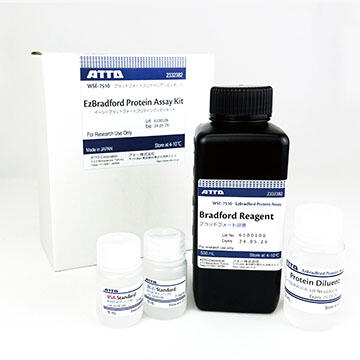
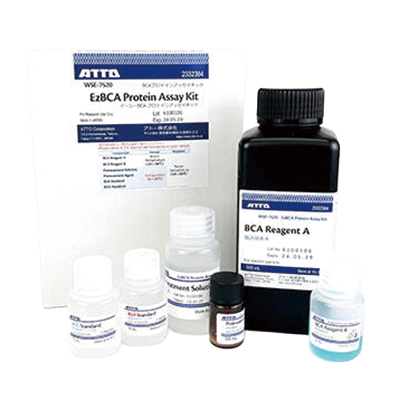
WSE-7520 EzBCA Protein Assay Kit
Purpose and Application
- Protein quantification by BCA method
Features
-
Quantification of proteins extracted from cells, tissues, and microorganisms
-
Suitable for protein quantification of electrophoresis samples using the BCA method
-
Total protein assay kit based on the BCA method
-
Rapid, simple, and highly accurate detection
-
Reduced interference from reducing agents and chelating agents through pretreatment
-
Includes pretreatment reagents to minimize the effects of reducing agents
-
Supplied with standard proteins for calibration (BSA and BGG)
-
Low interference from coexisting substances, ensuring excellent linearity and high accuracy
-
Measurement at 562 nmImmediate detection after mixing with protein (measurement of absorbance at 595 nm)
Description
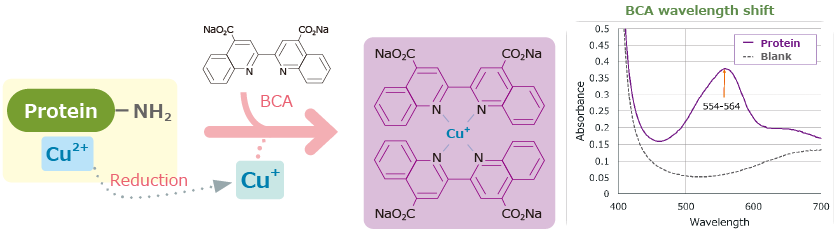
The BCA (Bicinchoninic Acid) method is a protein quantification assay based on the formation of a complex between proteins (peptides consisting of three or more amino acids) and copper ions. Amino acids with reducing properties—such as Cys, Tyr, and Trp—as well as peptide bonds, reduce copper(II) ions (Cu²⁺) to copper(I) ions (Cu⁺) in solution. Under alkaline conditions, BCA reacts with Cu⁺ to form a purple-colored complex. The absorbance of this complex is measured at 562 nm, and the protein concentration is determined using a calibration curve generated with standard proteins.
Although the reaction is compatible with detergents, it may be affected by reducing agents, thiols, glucose, ammonium sulfate, and other interfering substances.
Reference: Smith P. K., Analytical Biochemistry 150, 76–85 (1985).
The WSE-7520 EzBCA Protein Assay Kit is designed for total protein quantification using the BCA method. The kit includes BCA reagents (A and B), standard proteins (BSA and BGG), and pretreatment reagents to minimize interference from reducing agents. The recommended quantification ranges are 15–2000 μg/mL for the standard assay and 3–100 μg/mL for the low-concentration assay.
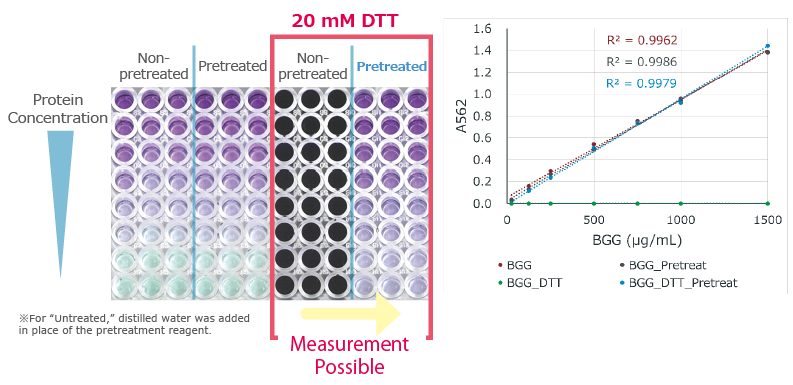
A dilution series of BGG standard was prepared with a final concentration of 20 mM DTT (BGG_DTT), and protein quantification was performed using the EzBCA Protein Assay Kit. In the presence of 20 mM DTT, color development was inhibited, and accurate quantification was not possible.
However, when the DTT-containing BGG samples were pretreated (BGG_DTT_Pretreat), the inhibitory effect of DTT was reduced, enabling accurate quantification with good linearity comparable to that of untreated BGG without DTT.
In addition, no differences in color development or measured values were observed between pretreated and non-pretreated BGG standard samples without DTT, indicating that the pretreatment step does not affect the assay performance.
These results demonstrate that the EzBCA Protein Assay Kit effectively reduces interference from reducing agents, allowing reliable protein quantification.
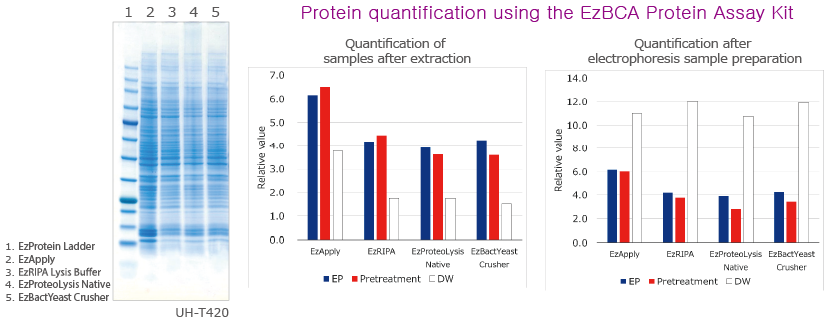
The graphs below show the results of protein quantification using the EzBCA Protein Assay Kit for proteins extracted from HeLa cells using EzApply, EzRIPA Lysis Kit, EzProteoLysis Native, and EzBactYeast Crusher. After extraction, samples were incubated at 37°C for 10 minutes with either pretreatment reagent (Pretreatment) or distilled water (DW), followed by quantification.
The left graph shows the quantification results of samples immediately after extraction, while the right graph shows results for electrophoresis samples prepared by adding DTT to the extracts and heating at 95°C for 5 minutes.
In addition, the electrophoresis patterns of these proteins, separated using u-PAGEL (UH-T420), are shown alongside. The gel images were analyzed using a CS analyzer, and the integrated intensity values of each lane were calculated and compared with the quantification results. Each graph plots relative protein concentration against relative integrated intensity.
These results demonstrate that protein quantification using the EzBCA Protein Assay Kit with pretreatment shows a high correlation with electrophoresis-based analysis.
| WSE-7510 EzBradford Protein Assay Kit | WSE-7520 EzBCA Protein Assay Kit | |
|---|---|---|
| Features | • Suitable for protein/electrophoresis samples • Rapid, simple, accurate • Not affected by reducing agents or chelators • Includes Protein Diluent (reduces detergent effects) • Includes standards (BSA, BGG) • One-reagent system | • Suitable for protein/electrophoresis samples • Rapid, simple, accurate • Less affected by detergents • Includes pretreatment reagents (reduces reducing agent interference) • Includes standards (BSA, BGG) • Low interference, high linearity & accuracy |
| Reagent Preparation | Not required | Mix Reagent A:B = 50:1 before use |
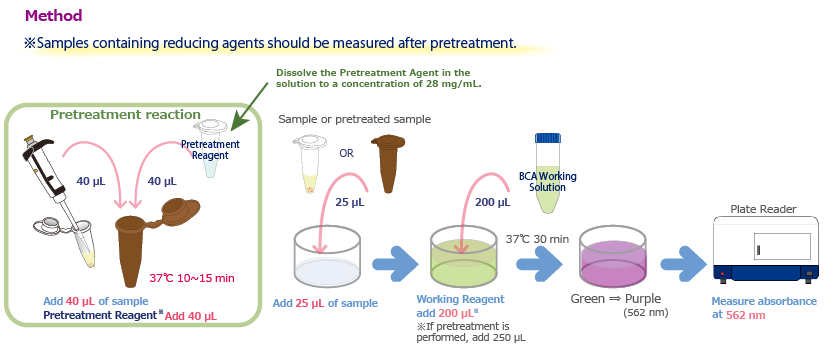
| Standard Assay | Sample: 10 μL Reagent: 200 μL | Sample: 25 μL Reagent: 200 μL 37°C, 30 min |
| Low Range Assay | Sample: 50 μL Reagent: 150 μL | Sample: 25 μL Reagent: 200 μL 60°C, 30 min |
| Wavelength | 595 nm | 562 nm |
| Capacity | ~2,500 wells | |
| Contents | 1. Bradford Reagent (500 mL) 2. Protein Diluent (50 mL) 3. BSA (2 mg/mL, 10 mL) 4. BGG (2 mg/mL, 10 mL) | 1. BCA Reagent A (500 mL) 2. BCA Reagent B (12 mL) 3. Pretreatment Solution (50 mL) 4. Pretreatment Agent (800 mg) 5. BSA (2 mg/mL, 10 mL) 6. BGG (2 mg/mL, 10 mL) |
| Storage | Refrigerated, light-protected (1 year) | |
The table below summarizes the permissible concentrations of coexisting substances in sample solutions that do not affect the reaction system of protein quantification reagents. Please note that, depending on the type and concentration of protein, the combination of reagents, and conditions such as pH, the reaction system may still be affected even at concentrations lower than those listed in the table.
| No additives | Surfactant-containing sample / Protein Diluent added | |
|---|---|---|
| WSE-7420 EzRIPA Lysis kit | 0.5x | 0.5x |
| WSE-7424 EzProteoLysis Native | 1x | 1x |
| WSE-7423 EzBactYeast Crusher | 0.5x | 1x |
| AE-1430 EzApply | 0.063x | 1x |
| Sodium Deoxycholate | - | 10% |
| SDS | - | 0.63% |
| Triton X-100 | 0.3% | 2.5% |
| NP-40 | 0.63% | 2.5% |
| Tween 20 | 0.63% | 0.63% |
| CHAPS | 10% | 10% |
| N-Octyl-β-D-glucopyranoside | 1.3% | 10% |
| n-Octyl-β-D-thioglucoside | 2.5% | 10% |
| Dodecyl-β-D-maltoside | 1.25% | 2.5% |
| 2-Mercaptoehanol | 40mM | 40mM |
| Dithiothreitol | 40mM | 40mM |
| TCEP | 40mM | 40mM |
| Glutathione | - | - |
| Cysteine | 40mM | 40mM |
| Tris/pH8.0 | 1M | 1M |
| Tricine/pH8.0 | 1M | 1M |
| HEPES/pH8 | 500mM | 1M |
| MOPS/pH8 | 1M | 1M |
| Sodium Phosphate Buffer | 500mM | 1M |
| PBS | 2x | 2x |
| TBS | 1x | 1x |
| Ammonium sulfate | 4M | 4M |
| Urea | 6M | 3M |
| Thiourea | 2M | 2M |
| Trichloroacetic acid | 750mM | 750mM |
| N,N-dimethylformamide | 20% | 20% |
| Dimethyl sulfoxide | 20% | 20% |
| Glycerol | 20% | 20% |
| Glucose | 20% | 20% |
| Sucrose | 20% | 20% |
| CaCl2 | 100mM | 100mM |
| MgCl2 | 125mM | 250mM |
| NaOH | 250mM | 250mM |
| HCL | 500mM | 500mM |
| MeOH | 40% | 40% |
| EtOH | 40% | 40% |
| EDTA | 200mM | 200mM |
| EGTA | 40mM | 40mM |
Instruction Manual
Specifications
| WSE-7520 EzBCA Protein Assay Kit | |
|---|---|
| Contents | ① BCA Reagent A: 500 mL ② BCA Reagent B: 12 mL ③ Pretreatment Solution: 50 mL ④ Pretreatment Agent: 800 mg ⑤ BSA Standard (2 mg/mL Bovine Serum Albumin): 10 mL ⑥ BGG Standard (2 mg/mL Bovine Gamma Globulin): 10 mL |
| Capacity | Approx. 2,500 wells |
| Sample Volume | *Working Reagent Mix BCA Reagent A and B at a ratio of 50:1 immediately before use. *Standard Assay Protein sample: 25 µL/well Working reagent: 200 µL/well Incubate at 37°C for 30 minutes. *Low-Concentration Assay Protein sample: 25 µL/well Working reagent: 200 µL/well Incubate at 60°C for 30 minutes. |
| Storage | Store refrigerated, protected from light |
| Shelf Life | 1 year (unopened, from date of manufacture) |
Ordering Information
| Code No. | Description | Unit |
|---|---|---|
| 2332384 | WSE-7520 EzBCA Protein Assay Kit | 1 set |
Related products
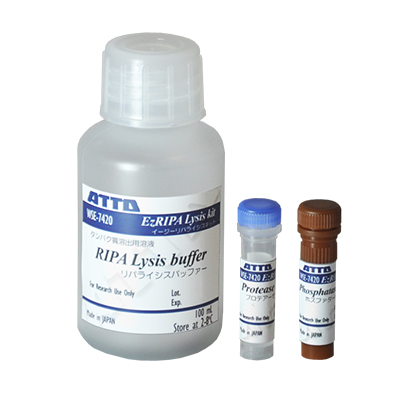
WSE-7420 EzRIPA Lysis kit
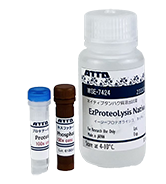
WSE-7424 EzProteoLysis Native
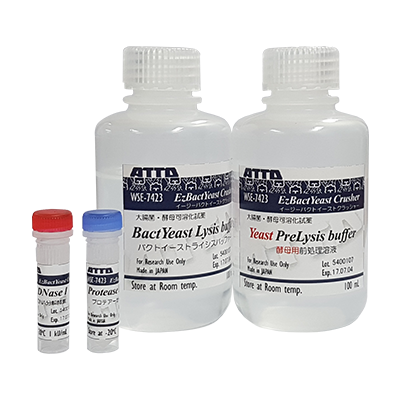
WSE-7423 EzBactYeastCrusher